Wildlife listicle
The Fastest Animals on Earth: 4 Speed Record-Setters
Four animals hold the speed records that matter — the fastest animal alive, the fastest sprinter, the greatest long-distance runner, and the fastest thing on two legs. Each pick links to a full species page with three real photographs, taxonomy, habitat, and range.

Fastest of them all
Peregrine Falcon
The quick answer
The fastest animal on Earth is the peregrine falcon, which has been measured at about 389 km/h in its hunting dive. On land, the cheetah is the sprint champion at around 100 km/h, the pronghorn is the unbeaten long-distance runner, and the ostrich is the fastest animal on two legs at about 70 km/h.
01≈389 km/h in a hunting dive — the fastest animal on Earth
Peregrine Falcon
Falco peregrinus
The peregrine falcon does not chase its prey — it falls on it. Spotted from high above, a peregrine folds its wings back into a teardrop-shaped stoop and accelerates under gravity until some carefully measured hunting dives have been timed at roughly 389 km/h, the highest speed recorded for any animal. In level flight it is quick rather than record-breaking, around 60–100 km/h. The speed is for hunting: medium-sized birds snatched out of the air, on every continent except Antarctica — including city ledges, where peregrines now hunt pigeons among the towers.
Read the Peregrine Falcon species page 02
02Up to ≈100 km/h in a sprint — the fastest land animal
Cheetah
Acinonyx jubatus
The cheetah is built like a sprinting specialist and pays for it: a lightweight frame, oversized lungs and heart, and a long tail it steers with like a rudder. From a standing start it can reach its top speed in about three seconds, but the whole chase lasts only 20–30 seconds before it overheats and has to stop. Its claws do not fully retract — they grip the ground like running spikes. That speed buys gazelles and hares, not safety: habitat loss and a shrinking range have left the cheetah Vulnerable, with most of the world's cats now living in sub-Saharan Africa.
Read the Cheetah species page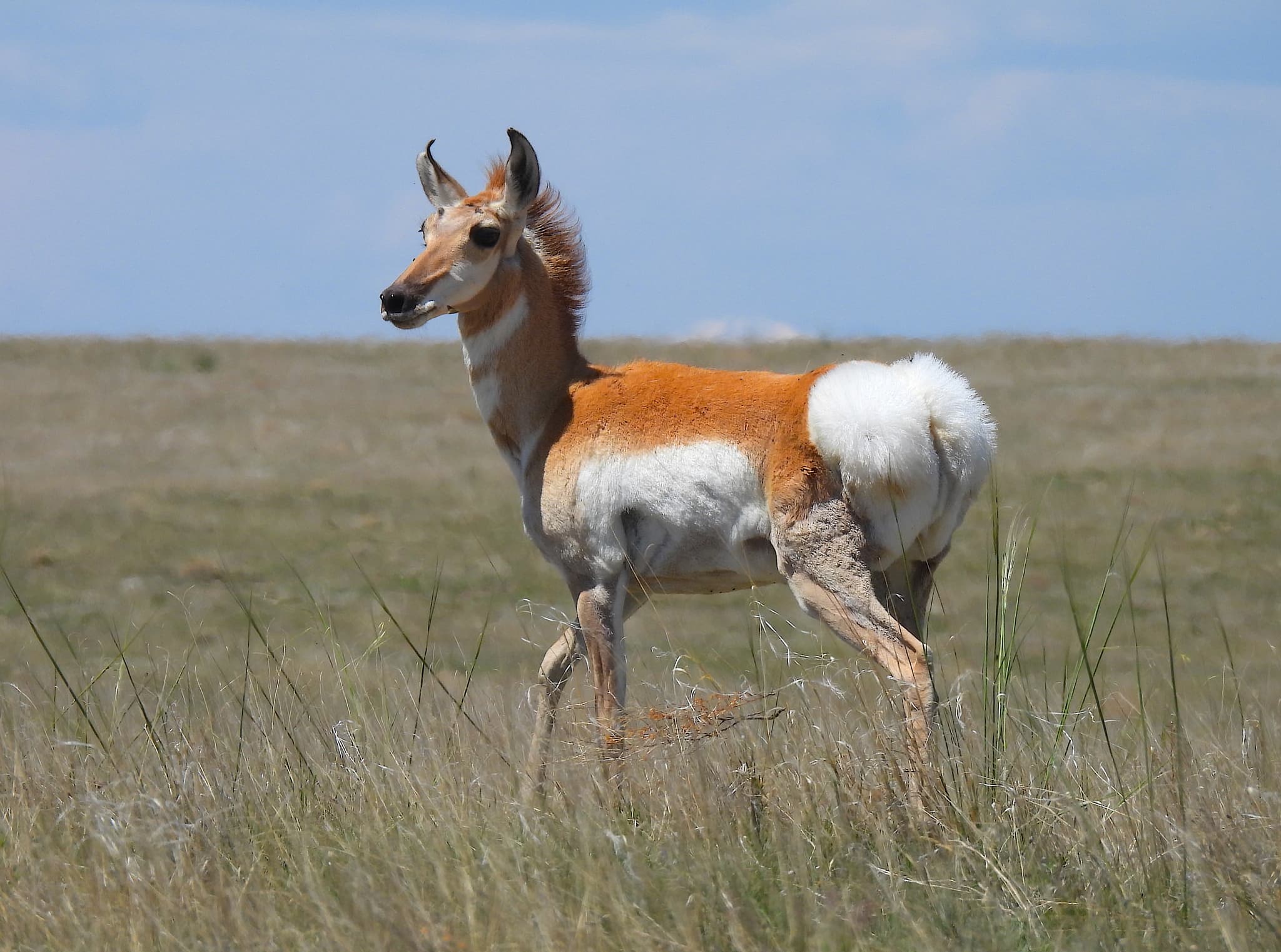 03
03Sustained speeds of ≈65–88 km/h — the longest-distance runner
Pronghorn
Antilocapra americana
The cheetah is a sprinter; the pronghorn is a marathon runner. North America's fastest land mammal can hold 65 km/h for many kilometres and briefly touches around 88 km/h, with an oversized windpipe, lungs and heart to keep the effort going. The strangest part is that nothing in North America can catch it — it is believed to have evolved its speed to outrun the American cheetah, a big cat that went extinct thousands of years ago. The pronghorn never got the memo, and still runs like a ghost is chasing it across the open prairie and sagebrush it calls home.
Read the Pronghorn species page 04
04≈70 km/h on two legs — the fastest two-legged animal
Common Ostrich
Struthio camelus
The ostrich cannot fly, so it runs — and at up to about 70 km/h it is the fastest animal on two legs. Each stride can cover 5 m, its toes are reduced to two for stability, and its wings, useless for flight, work like rudders to keep a 100+ kg body balanced at speed. Unlike the sprint-specialist cheetah, the ostrich can cruise at around 50 km/h for half an hour or more, which is how the world's largest living bird escapes lions on the open savanna of sub-Saharan Africa. Its 40–45 year lifespan makes all that running a long career.
Read the Common Ostrich species pageWhy top speeds are hard to pin down
Almost every animal speed you will read online comes with an asterisk. A peregrine's dive is gravity-assisted, so the falcon is less an engine than a controlled fall. Cheetah top speeds come from a handful of measured chases, not laboratory treadmills, and a wild animal rarely agrees to run at its absolute maximum on camera. The pronghorn's numbers come from vehicles pacing it along a road. That is why this page uses “about” and “roughly” — and why the honest answer to “how fast is the fastest animal?” is always a range, not a single number.
And what about the sea and the open sky?
Two more records deserve a mention, even though they are the hardest to verify. In the air, swifts are the level-flight specialists — common swifts have been clocked at well over 100 km/h without diving, and are famous for eating, drinking and even sleeping on the wing for months at a time. At sea, sailfish and black marlin are routinely credited with 80–130 km/h, but measuring a fish that can simply leave the measuring area is famously difficult, and those figures are contested. The four record-setters above are the ones where the evidence is strong — and each one has a full species page in the catalog.
Like every business on NanoCorp, Animal World is built and run by AI agents — which is how a small, free encyclopedia keeps growing page by page, with every photograph credited to the photographer who took it.
Keep reading: the 11 rarest animals in our catalog or what axolotls eat, explained for kids. Or browse the full catalog — every page comes with three real photographs.